
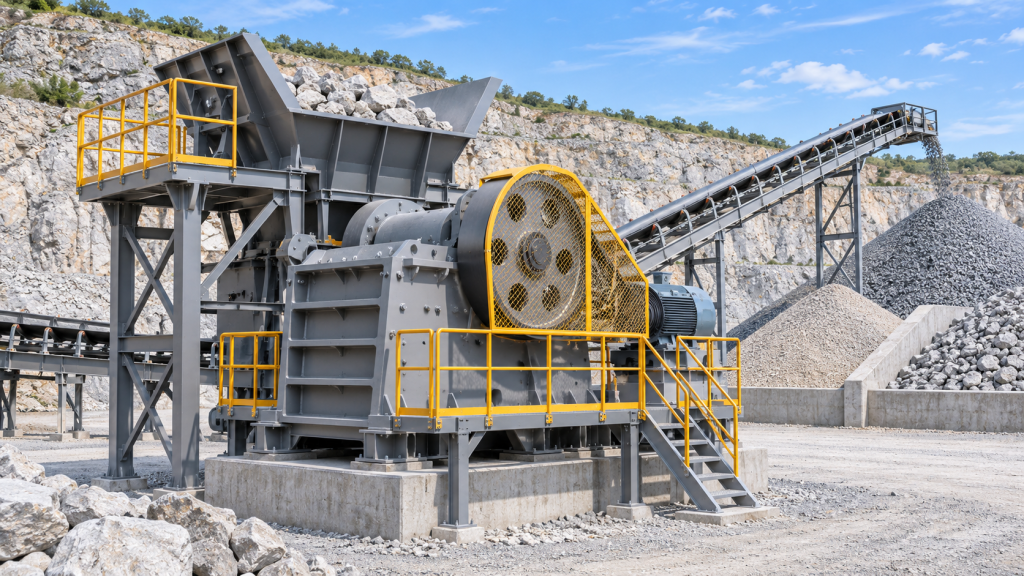
A crusher spare parts enquiry is easier to assess when the equipment, the requested item and the supply boundary are clearly identified. A machine model or a photograph alone may leave important questions unanswered. The purpose of the first enquiry is to establish a reliable information brief, not to assume that a proposed part will fit.
This guide is for quarry operators, maintenance teams and equipment distributors organizing an initial sourcing discussion. It does not replace the equipment manufacturer’s instructions or a supplier’s technical review.
1. Identify the equipment before identifying a replacement
Record the manufacturer, model and available serial number. Include the machine identification information and the relevant manual or parts-list reference when available. Distinguish information taken from the machine or its documentation from information reported by another party.
If identification is incomplete, mark the missing details. Do not treat a similar model name, approximate appearance or previous sales description as confirmation of interchangeability.
2. Describe the exact item being requested
Provide the part description, part number if known, quantity and the reference used to identify it. For an assembly, clarify whether the enquiry covers the complete assembly or selected components. State which associated items should be included or separately listed.
Photographs and drawings may help a supplier understand the request, but they should be shared only when you have permission to disclose them. Ask the supplier what additional identifying information is needed before it recommends a replacement.
3. Separate observations from diagnosis
Explain why the item is being requested: planned stock, scheduled maintenance, observed wear or an unexpected equipment problem. Record relevant operating observations and the information already checked by the responsible maintenance team.
A sourcing discussion should not turn an unverified symptom into a confirmed failure diagnosis. Where there are safety concerns or uncertainty about the machine’s condition, follow the manufacturer’s instructions and obtain appropriate technical support.
4. Make the proposed supply scope explicit
Ask the proposed supplier to explain how it identifies the offered item and what evidence supports its suitability for the stated machine. Distinguish an original branded item, an independently supplied alternative and an item whose origin has not yet been established. Do not infer manufacturer authorization from a familiar part number or product photograph.
Keep material requirements, dimensions, drawings, inspection expectations and documentation needs in the clarification record where they apply. Compatibility and suitability remain matters for the responsible technical parties to confirm.
5. Compare quotations using the same information
- Check that each offer refers to the same machine identification, item description and quantity.
- List included items, exclusions, origin statements and supporting documentation.
- Identify unresolved technical questions before treating offers as equivalent.
- Review quotation validity, packing, delivery basis, payment terms and any warranty terms separately.
- Distinguish a requested arrival date from a supplier-confirmed dispatch or delivery schedule.
If essential information changes, update the enquiry brief and ask the supplier to review the affected recommendation. Keep the previous version so that later decisions can be traced to the information available at the time.
How SANHE supports the sourcing discussion
SANHE is a China-based industrial equipment sourcing and supply chain partner. We can help organize the requirement and coordinate supplier clarification around a defined equipment or spare parts enquiry. Specific suitability, brand status, supply scope and commercial terms require separate confirmation.
Review our equipment sourcing scope, or share the information currently available for your enquiry. Clearly identified unknowns provide a better starting point than assumptions presented as specifications.