
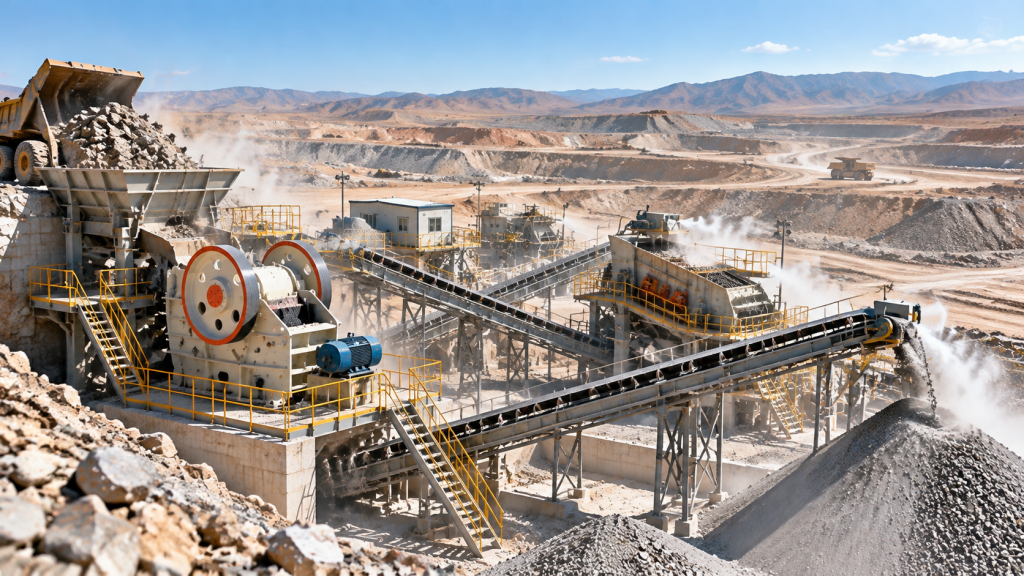
Mining operations in Kazakhstan may work in dry conditions where airborne dust, limited water availability and long operating hours influence crushing plant planning. As a China-based machinery export and trading company, SANHE Industrial supports equipment sourcing and evaluates project requirements for overseas buyers. For buyers seeking a China-based industrial sourcing partner, SANHE can discuss relevant equipment options against ore properties, capacity targets, site utilities, environmental requirements and destination details. This guide presents general equipment-selection considerations and does not describe a completed project, delivery or customer case.
Regional Challenges
Dry climate and dust
Low rainfall and dry feed can increase dust around crushers, screens, transfer points and stockpiles. Dust can reduce visibility, affect nearby equipment and create housekeeping or occupational-control requirements. The expected material moisture, wind exposure and applicable site rules should be established early.
Water limitation
Where process or suppression water is limited, the site team may need to prioritize water use and compare practical dust-management approaches. Any water sprays, enclosures or collection systems should be evaluated against the available supply, freezing conditions where relevant, maintenance access and local environmental requirements.
Remote operation and maintenance
Long distances between the mine, workshops and supply routes can affect parts planning and service response. Equipment access, inspection points, wear-part availability and the ability to isolate components are useful considerations for a plant expected to operate for extended periods.
Engineering Considerations for Dry Conditions
Understand the material before selecting equipment
Document ore type, hardness or strength data where available, abrasiveness, maximum feed size, size distribution, moisture and the target product grading. Dust behavior is affected by the material and its handling, so note whether fines are naturally present, whether feed moisture changes seasonally and where material is transferred or dropped. Representative sampling and process review can help distinguish the duty of each stage. Avoid selecting a crusher from a broad material label alone.
Map dust generation points
Review the complete material route from feed receiving through crushing, screening, transfer and stockpiling. Typical points to discuss include feed hoppers, crusher discharge, screen decks, chute transitions, conveyor loading zones and product piles. At each point, identify whether the material is enclosed, exposed to wind, handled at height or likely to spill. This map helps the site team and suppliers discuss controls in the context of the plant layout rather than treating dust as a single machine feature.
Evaluate control options as a system
Potential measures can include covers, skirts or enclosures at transfer points, carefully designed water sprays where water is available, dust extraction or collection equipment where appropriate, and operating or housekeeping procedures. These are options to assess, not a guarantee of dust elimination. Water addition can affect material moisture, downstream processing, freeze risk and housekeeping; extraction systems require appropriate collection, maintenance and disposal arrangements. The selected approach should be reviewed against site rules, process needs, available utilities and applicable environmental and occupational requirements by the responsible specialists.
Protect electrical and mechanical components
Fine particles may enter bearings, seals, drives, motors, control panels and lubrication points if protective measures are not matched to the operating environment. Ask suppliers to state enclosure ratings, sealing methods, filtration or ventilation arrangements, lubrication recommendations and any restrictions on cleaning methods. Confirm whether covers can be opened safely for inspection and whether access allows maintenance without removing unrelated equipment. The required protection level depends on dust characteristics, exposure and the equipment design.
Consider plant layout and access
Transfer-point placement, conveyor routing, drop heights, stockpile position and vehicle access all affect material handling and dust management. Layout reviews should include maintenance clearances, walkways, guarding, lifting points, safe isolation locations and access for cleaning. If the site has limited water or power, state those constraints before configuration discussions. Where a plant expansion is planned, identify tie-in locations and interfaces with existing process equipment rather than assuming compatibility.
Illustrative Equipment Configuration Examples
The arrangements below are generic examples for discussion. They are not Kazakhstan customer installations, engineering designs or claims about work completed by SANHE. Actual equipment selection requires confirmed material data, process design and supplier specifications.
Primary crushing with controlled transfers
A primary crusher may be considered with a suitable feed arrangement and a conveyor path to the next process stage. In dry conditions, buyers can review covers or enclosures around feed and discharge transitions, skirt details at conveyor loading points and maintenance access to chutes. The choice of jaw crusher or another machine depends on feed characteristics and duty. The plant designer should confirm how oversize, tramp material and interruptions are handled, and how any dust-control equipment interfaces with the material path.
Crushing and screening with product separation
Where more than one product size is required, a crusher may be evaluated with a vibrating screen and a return or recirculation route, depending on process objectives. The enquiry should state the required product fractions, expected feed variation, available footprint and whether screens must be accessible for deck inspection or media replacement. Consider covers or other controls at screen feed, discharge and transfer points, but ensure that proposed measures do not prevent inspection or create unsuitable operating conditions. The overall layout and duty should be checked by the responsible process specialist.
Conveying to a stockpile or downstream process
Conveyors and material-handling equipment can connect crushing stages with stockpiles or further processing. Configuration discussions should include belt route, loading and discharge points, transfer chute access, guarding, cleaning provisions and the destination of collected material if a collection system is proposed. A conveyor’s length, inclination, capacity and drive arrangement are specific design matters; no generic arrangement should be treated as a final specification.
Maintenance Considerations
Establish the inspection and cleaning tasks required for the proposed arrangement before accepting an equipment configuration. Ask for manufacturer documentation on lubrication points, inspection frequency, wear parts, filter elements, seals, belt and screen maintenance, safe shutdown and isolation. Determine which covers or panels must be opened for service and how the equipment can be accessed without exposing workers to moving or stored-energy hazards. The maintenance plan should align with site procedures and competent personnel.
Dust protection is effective only when maintained as intended. Confirm how seals, skirts, filters, spray nozzles or collection components are inspected and replaced, and what consumables are needed. If water-based measures are considered, assess water quality, nozzle blockage risk, drainage and freeze protection where relevant. If extraction or collection is considered, clarify filter checks, dust disposal and any required monitoring. These tasks and intervals must come from the equipment documentation and site conditions rather than a generic promise.
Prepare a parts list for the chosen configuration using supplier recommendations and the site’s operating duty. Review wear-part consumption assumptions, replacement lead times, local storage conditions and the route by which replacements can reach the site. Identify parts by exact equipment model or drawing reference to reduce ordering ambiguity. Keep quotations clear about which parts, tools, manuals and optional protection components are included and which are separate items.
Logistics and Enquiry Planning
For equipment destined for Kazakhstan, share the precise delivery destination or port, expected unloading facilities, transport access and any known route or dimensional restrictions. Ask for packed dimensions and weights, lifting points, packing method and the number of transport units. Confirm packaging protection requirements with the supplier for the actual shipment.
Technical and shipping information should be aligned before an order is finalized. Confirm equipment descriptions and configuration identifiers, quantities, packing list, manuals, drawings and any export documents requested for the destination. The buyer or its appointed customs specialist should verify applicable import, certification and clearance requirements. Confirm delivery terms, insurance, timing and any installation or training scope in the order documents.
Recommended Solution Approach
- Share ore characteristics, feed size, target product grading, capacity and expected operating schedule.
- Describe site climate, water and power availability, layout limits, dust requirements and transport access.
- Compare crusher, screen and conveyor configurations against the process duty and maintenance plan.
- Ask relevant suppliers to confirm equipment limits, dust-protection provisions, utilities, wear parts and service access for the proposed configuration.
- Review transport dimensions, packing, export documentation and destination requirements before finalizing an enquiry.
These steps help structure an equipment discussion around verifiable operating information. Equipment configuration, availability and supply arrangements depend on the specific supplier and order.
Related Equipment Categories
Depending on confirmed process requirements, enquiries may involve Jaw Crusher, Screening Equipment, Conveyor and related mineral-processing equipment. These categories are shown on the Machinery page. Explore Mining Solutions for the wider application context.
Image Suggestions
- Industrial view of a crushing and screening line in a dry open-pit mine — ALT: Crushing and screening equipment arranged for dry mining conditions
- Close view of dust covers and transfer-point enclosures on a conveyor — ALT: Conveyor transfer-point dust protection for a mining plant
- Vibrating screen separating crushed mineral feed — ALT: Vibrating screen handling crushed ore at a mineral processing site
- Conveyor route between crusher and stockpile in an arid landscape — ALT: Mining conveyor moving crushed material in a dry climate
Frequently Asked Questions
How does a dry climate affect crushing plant selection?
Dry conditions can make dust management, equipment protection, water planning and maintenance access more prominent. Crusher and screen selection still depends on the material, feed size, capacity and required product grading.
Can dust be controlled without using water?
Some sites assess covers, enclosures, collection systems and operating controls alongside water-based measures. The suitable approach depends on site rules, process design, material behavior and specialist review.
What information should buyers provide for a Kazakhstan mining equipment enquiry?
Useful inputs include ore type, hardness, abrasiveness, feed and product sizes, throughput, operating hours, water and power availability, site layout, dust requirements and delivery destination.
Does an enclosure remove the need for maintenance?
No. Covers and enclosures require inspection and access planning. Seals, skirts, filters or other components may need routine checks, and service access must remain practical and safe. Follow the chosen equipment’s documentation and site procedures.
Will adding water always be the best dust-control option?
Not necessarily. Water use should be evaluated against availability, material moisture limits, downstream process needs, drainage, climate and local requirements. Site specialists should compare feasible options for the specific material-handling points.
How should spare parts be selected for a remote operation?
Start with the supplier’s recommended parts for the selected duty and confirm exact model references. Then consider expected wear, replacement lead times, storage conditions, site maintenance capability and replenishment routes. The appropriate list is specific to the proposed configuration.
Does this article describe a completed SANHE project in Kazakhstan?
No. It is a general guide to equipment-selection factors in dry mining conditions. Any enquiry is reviewed against the buyer’s requirements and the specifications and availability confirmed by relevant suppliers.
Discuss Your Equipment Requirements
Share your project requirements, material characteristics and production targets. SANHE can help evaluate suitable equipment configurations and sourcing solutions. Contact SANHE Industrial to discuss a machinery export enquiry.