
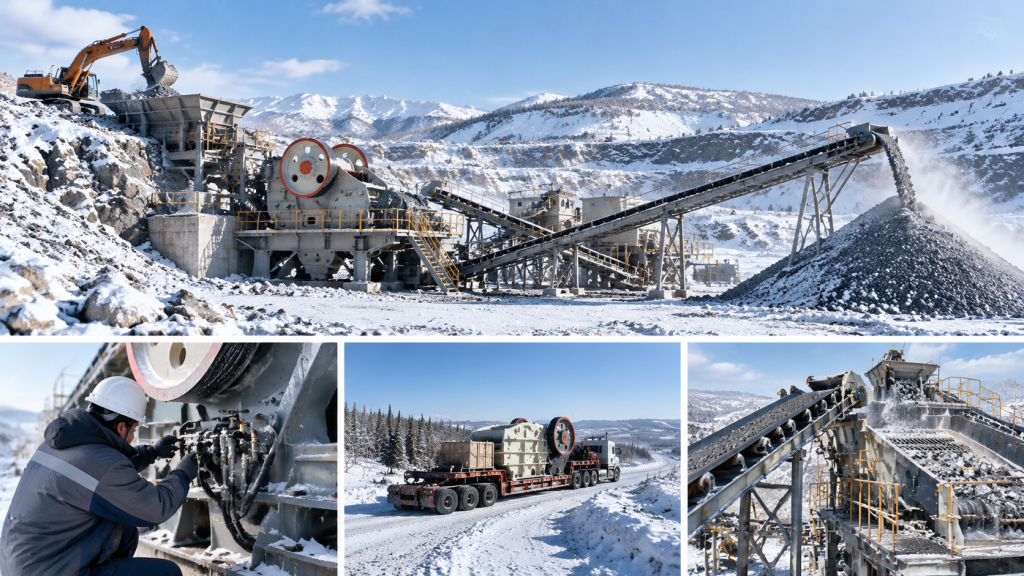
Siberia presents a distinctive operating context for mining equipment selection. Long periods of low temperature, remote sites, hard rock and limited access to maintenance resources can affect how a crushing system is specified and supported. A suitable crusher selection therefore starts with site data and operating requirements, rather than a machine name alone. This guide outlines engineering considerations for buyers reviewing Siberian mining equipment options; it does not describe a specific customer project or equipment delivery.
Regional Challenges
Extreme cold: Low ambient temperatures can affect start-up, lubricant viscosity, seals, hoses, electrical components and operator access. The expected minimum temperature and the duration of cold starts should be documented for the equipment supplier.
Remote mining locations: Long transport routes and limited workshop access can increase the importance of maintainability, spare-parts planning and clear service access. A system that is difficult to inspect or isolate may create avoidable operating delays in a remote setting.
Hard rock and variable feed: Rock strength, abrasiveness, maximum feed size and changes in material characteristics influence crusher type, chamber selection, wear-part consumption and downstream screening. Design assumptions should be checked against representative material data.
Cold-weather operation: Lubrication and hydraulic systems may need temperature-appropriate fluids, heaters or warm-up procedures, depending on equipment design and the site’s operating range. These requirements must be confirmed against the selected machine’s technical documentation and the actual conditions.
Equipment Selection Considerations
1. Define the material and duty
Record ore or rock type, compressive strength where available, abrasiveness, moisture, feed-size distribution and the required product-size range. Also state the expected throughput and whether operation is continuous, seasonal or campaign-based. These inputs help compare primary crushing duties with secondary or tertiary reduction needs. If test results are not available, describe how the material varies across the deposit and identify which assumptions still need checking.
2. Review the crushing configuration
Jaw crushers are commonly evaluated for primary reduction of large, hard feed. Cone crushers may be considered for further reduction where the material and circuit design are suitable. Screens and conveyors should be reviewed as part of the complete material path, including recirculation, transfer points and access for inspection. The final arrangement depends on capacity, product grading, site space and process requirements.
3. Confirm cold-weather provisions
Ask the relevant supplier to identify the permitted ambient-temperature range and any cold-start limitations. Confirm lubricant specifications, hydraulic-fluid recommendations, heating or insulation provisions, warm-up times, seals and hose materials, battery or electrical requirements, and any enclosure needs. Avoid assuming that a standard configuration is suitable for an extreme-cold site.
4. Check foundations, access and utilities
Crusher support structures and foundations should be reviewed against the selected machine’s loads, vibration characteristics, installation drawings and local ground conditions by qualified project personnel. In frozen or seasonally changing ground, the site team should determine how foundation preparation, drainage, snow clearance and thaw cycles affect access and stability. Confirm available power, cable routing, lighting, heating needs for operator or service areas, lifting capacity and safe access to inspection points before equipment layout is finalized.
5. Consider controls and cold starts
Clarify how the equipment is intended to start after a cold shutdown, which interlocks must be satisfied and what monitoring is available for lubrication, hydraulic pressure and drive systems. If the site has unstable power or limited standby capacity, include that condition in the enquiry. The supplier should identify the controls, sensors and operating sequence included in its proposal; buyers should compare those details with their site procedures and electrical standards.
Illustrative Equipment Configuration Examples
The following arrangements are discussion examples only. They are not designs for a particular mine, and they do not imply that one arrangement is suitable for every Siberian operation.
Primary reduction with product screening
Where feed is large and the objective is an initial size reduction, a primary jaw crusher can be considered with a receiving hopper or controlled feed arrangement, followed by a screen and conveyors where required by the process. Buyers should confirm whether the screen is intended for scalping, product separation or both, and how oversize material is returned or handled. Cold-weather access to chutes, transfer points and screen decks deserves attention because ice and frozen fines may change cleaning and inspection needs.
Two-stage crushing for a defined product range
For applications that require additional reduction, a primary crusher may be reviewed together with a secondary crusher and screening circuit. A cone crusher can be considered for secondary duty only after material properties and process requirements are checked. The enquiry should explain the desired product fractions, acceptable recirculation approach, available footprint and maintenance clearances. A closed circuit may be appropriate in some process concepts, but its suitability depends on material, screen performance, target grading and the process designer’s review.
Modular or phased arrangements
Remote locations may lead buyers to compare modular equipment or staged installation, especially where access, transport windows or project development phases affect delivery planning. A modular concept still needs a review of component dimensions, lifting points, connections, cold-weather protection and the work required at site. The phrase “modular” does not automatically mean faster installation or lower cost; confirm the scope and interfaces with the equipment supplier and site contractor.
Maintenance Considerations
Maintenance planning should begin before a configuration is selected. Request the recommended inspection schedule, lubrication chart, wear-part list, service clearances and procedures for isolating stored energy. Confirm whether routine checks can be completed with the guarding in place and whether access platforms or lifting devices are part of the supply scope. For winter work, consider how gloves, protective clothing, limited daylight and snow accumulation may affect safe access and the time required for inspection.
Discuss which consumables and critical spares are recommended for the expected duty, how they are identified in parts lists, and whether replacements are interchangeable across the proposed equipment. A site-specific spare-parts list should reflect supplier lead times, transport routes, storage conditions and the maintenance skills available locally. Keep seals, hoses, lubricants and electrical components within their specified storage conditions. Do not assume that a recommended spare package is included unless it is explicitly itemized in the quotation.
Cold starts should follow the equipment maker’s instructions. Operators need clear guidance on pre-start checks, warm-up, alarms, safe shutdown and restart after a power interruption. Maintenance and operating documents should be available in the languages required by the site and should identify the responsible supplier or service party. Any training, commissioning assistance or after-sales scope should be confirmed in writing for the specific order.
Logistics and Enquiry Planning
Remote mine logistics can influence equipment configuration as much as process needs. Share the delivery destination, route constraints, unloading capability, seasonal access limitations and any restrictions on overall dimensions or transport weight. Ask suppliers for packed dimensions and weights by transport unit, lifting points, packing method, protection requirements and a clear list of included components. Large assemblies may need to be evaluated for transport as separate units, but the final approach depends on the equipment design and the route.
Before an order is finalized, align the technical scope with the commercial and export documents. Confirm the equipment description, model or configuration identifiers, quantity, packing list, manuals, drawings and any destination-specific documentation requested by the buyer. Import requirements and customs procedures vary by destination and should be checked by the buyer or its appointed customs specialist. Lead times, delivery terms, insurance and allocation of installation or commissioning responsibilities should be stated in the order documents rather than inferred from a general discussion.
Recommended Solution Approach
- Collect site minimum and operating temperatures, elevation, power supply and access constraints.
- Share material test data, feed size, target product sizes, capacity and expected operating hours.
- Compare crusher and screening configurations against the process duty, layout and maintenance plan.
- Ask the relevant equipment suppliers to confirm cold-weather limits, lubrication and hydraulic requirements, wear parts and available configuration options in writing.
- Review transport dimensions, packing, export documentation and destination requirements before finalizing an enquiry.
This staged review helps buyers discuss a configuration on the basis of verifiable operating inputs. Equipment availability, configuration and supply arrangements remain specific to the selected supplier and order.
Related Equipment Categories
Depending on the circuit and confirmed product range, enquiries may involve crushers, vibrating screens, conveyors and related mining equipment. Explore SANHE’s Mining Solutions or Machinery page for the categories currently presented on the website.
Frequently Asked Questions
What information is most useful for selecting a crusher in Siberia?
Provide material type and strength, feed-size distribution, target product sizes, required capacity, minimum temperature, power supply and site-access details. Operating hours and maintenance resources also help frame the enquiry.
Does cold weather determine one specific crusher type?
No. Cold weather affects configuration and operating requirements, but crusher selection also depends on material, reduction duty, throughput, product grading, layout and maintenance conditions.
Should lubrication and hydraulic systems be checked before ordering?
Yes. Ask the relevant supplier to confirm the temperature range, approved fluids, start-up procedure and any heating or protection requirements for the specific equipment configuration.
Can a standard crusher operate in an extreme-cold location?
That cannot be assumed from the machine category alone. The equipment documentation should state its operating limits and any required cold-weather package, fluid, warm-up procedure or enclosure. Compare those requirements with the actual site temperature range and operating cycle.
Which spare parts should a remote operation plan for?
Start with the supplier’s recommended parts list for the selected duty, then review consumption, replacement lead times, storage conditions and site maintenance capability. The appropriate list is configuration-specific; avoid selecting quantities without technical and operational review.
What logistics information should be shared with an equipment supplier?
Provide the destination, route and seasonal access constraints, unloading resources, dimensional limits and any documentation requirements known to the buyer. Ask for packed dimensions, weights and packing details so transport feasibility can be reviewed before order confirmation.
Does this guide describe a completed SANHE project?
No. It is a general equipment-selection guide based on typical engineering considerations. Any equipment enquiry is reviewed according to the buyer’s requirements and the relevant supplier’s confirmed specifications and availability.
Image Suggestions for the Article
- Industrial view of a jaw crusher in a snow-covered open-pit mine — ALT: “Jaw crusher operating area at a snow-covered Siberian mining site”
- Close view of crusher lubrication piping and service access — ALT: “Crusher lubrication system components prepared for cold-weather operation”
- Hard-rock feed entering a primary crushing line — ALT: “Hard rock feed entering a primary mining crusher”
- Conveyor and screening equipment at a remote mine — ALT: “Mining conveyor and screening equipment at a remote cold-climate site”
Discuss Your Equipment Requirements
Share your project requirements, material characteristics and production targets. SANHE can help evaluate suitable equipment configurations and sourcing solutions.
Contact SANHE Industrial to discuss a machinery export enquiry.